Common Design Elements in Streetwear
Streetwear design tends to rely on familiar building blocks rather than constant reinvention. These elements create continuity across collections and decades, even as trends shift. Materials, silhouettes, and surface details often repeat because they function well in daily life, not because they aim to impress in controlled settings.
Fabric Choices and Construction
Cotton jersey, fleece, denim, and canvas are common fabrics in streetwear. They are widely available, relatively affordable, and hold up under frequent wear. Heavier weights are often favored because they give garments structure and help them age in a predictable way over time.
Construction tends to be straightforward and visible. Reinforced seams, ribbed cuffs, and double stitching appear often. These details serve a practical purpose, but they also signal reliability. Clothing that looks capable of handling wear becomes part of how streetwear communicates usefulness and longevity.
Color Palettes and Layering
Streetwear often relies on restrained color palettes. Black, white, gray, navy, and muted earth tones form a base that allows pieces to be worn together without much planning. When bright colors appear, they are usually limited to specific areas like graphics or trims.
Layering is another defining element. Hoodies under jackets, long shirts beneath shorter layers, and visible hems all contribute to a look that feels assembled over time. These combinations reflect movement through different spaces rather than dressing for a single, fixed occasion.
Streetwear Graphics and Symbolism
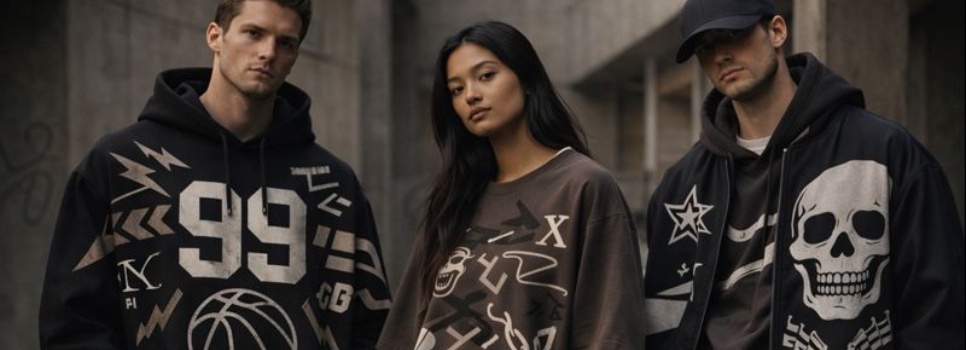
Graphics are one of the most recognizable features of streetwear. They function as visual shortcuts, communicating references and attitudes quickly. Rather than aiming for decoration alone, graphics often point to music scenes, sports culture, local environments, or shared social experiences.
Symbolism in streetwear is rarely subtle. Messages are meant to be noticed and understood by those familiar with the context. Meaning is often implied rather than explained, creating a sense of inclusion for those who recognize the reference.
Typography and Text-Based Graphics
Text plays a central role in streetwear graphics. Bold lettering, block fonts, and hand-drawn styles appear frequently. Words may be oversized, cropped, or partially obscured, creating tension between clarity and expression.
Short phrases, location references, or slogans are common. These texts are not always descriptive. Their impact comes from recognition and repetition rather than from clear messaging, reinforcing the idea that streetwear speaks within a shared visual language.
Symbols, Icons, and Repetition
Simplified symbols such as numbers, arrows, mascots, or abstract icons appear repeatedly across streetwear designs. Over time, repetition gives these elements meaning. A symbol becomes recognizable not because of explanation, but because of continued use.
Why Streetwear Often Uses Oversized Fits
Oversized fits are one of the most visible characteristics of streetwear. They are sometimes treated as a trend, but their origins are practical and cultural. Loose silhouettes developed alongside the environments where streetwear was worn and have remained relevant for consistent reasons.
Rather than emphasizing tailoring or body shape, streetwear often prioritizes comfort and ease. The fit supports movement and reflects a relaxed relationship with formal dress expectations.
Comfort, Movement, and Function
Loose clothing allows for greater freedom of movement. Activities associated with early streetwear, such as skateboarding or dancing, place physical demands on garments. Tight fits restrict motion and tend to wear out faster in high-friction areas.
Oversized fits also adapt more easily to different body types. This flexibility supports the informal and shared nature of streetwear, where garments are layered, borrowed, or worn without strict sizing rules.
Identity, Space, and Visual Presence
Oversized clothing changes how a person occupies space. It shifts focus away from the body and toward the overall silhouette. This aligns with streetwear’s emphasis on presence rather than refinement.
Larger garments also provide more surface area for graphics and textures. Logos, text, and imagery become easier to see from a distance, which matters in busy public environments. Visibility becomes part of how streetwear communicates identity.
Where Visual Consistency Meets Everyday Use
Streetwear design holds itself up by mirroring the wearing of clothes. Emanating from the repetitiveness, familiarity, and association with everyday appointments in life, its components take a down-to-earth description. Fabrics are based on everyday comfort, graphics relate to their shared references, oversized fits struggle for ease of movement.
Streetwear builds its value on steady power instead of fpr momentary pure novelty. While the seeming language remains the same, it influences changes in its application herein, adapting to these changes without losing its essence. This internal dynamics in turn stave off its existence. That refined sometimes leads one to see the ability of streetwear to be similarly meaningful to various generations and across various scenes.